

Impact highlights
Sensor once used in food production helps transform mine tailings waste

Sector
Achieving resilient environments and livelihoods
Innovators
Professor Alexander Scheurmann, Dr Thierry Bore, Associate Professor Konstanty Bialkowski
Overview
Sensor once used in food production helps transform mine tailings waste
Commercialisation
Patent application, Licence intellectual propertyFor decades, the mining industry’s approach to tailings management was largely out of sight and out of mind.
“The alternative is you pump the ore tailings into the dam, leave it for 10 years and hope for the best,” explains Phibion CEO Jacques Janse. “That approach is no longer acceptable.”
Over the past decade, catastrophic tailings dam failures in Brazil caused hundreds of fatalities and widespread environmental devastation, fundamentally changing how the industry manages its waste.
Tailings management is now a critical global focus area. Tailings, the toxic, slurry-like waste left after ore processing, are typically stored in dams that can span hundreds of hectares.
If poorly managed, they pose significant environmental and safety risks. Yet monitoring has traditionally been slow, indirect and reactive.
A technology reimagined
Researchers from The University of Queensland, led by Professor Alexander Scheuermann from the School of Civil Engineering, identified an opportunity to adapt a technology originally used in food production, dielectric sensing, for application in mining.
By sending radio signals into tailings material and interpreting the signals that bounce back, dielectric sensors detect moisture variations within the slurry.
When combined with advanced calibration algorithms, the system enables operators to estimate moisture content, density and material strength.
These parameters are critical indicators of tailings stability. The result is near real-time insight into tailings conditions, allowing operators to make informed, proactive decisions that improve safety and operational efficiency.
A Queensland partnership
Brisbane-based company Phibion specialises in Accelerated Mechanical Consolidation (AMC™), a process that rapidly dewaters and compacts tailings to create stable, trafficable, and rehabilitable surfaces.
When Phibion founder David Smirk challenged UQ researchers to improve real-time tailings monitoring, a collaboration was formed.
Supported by an Australian Government Innovation Connections Grant and co-investment from Phibion, Professor Scheuermann, Dr Thierry Bore and Associate Professor Konstanty Bialkowski (School of Electrical Engineering and Computer Science) adapted dielectric sensing technology for the demanding tailings environment.
UniQuest negotiated an exclusive licence granting Phibion global commercial rights for the technology in tailings and slurry management.
The partnership strengthens Phibion’s international competitiveness while ensuring innovation, manufacturing capability and high-value expertise remain in Queensland, supporting up to 400 local jobs.
The sensor in action
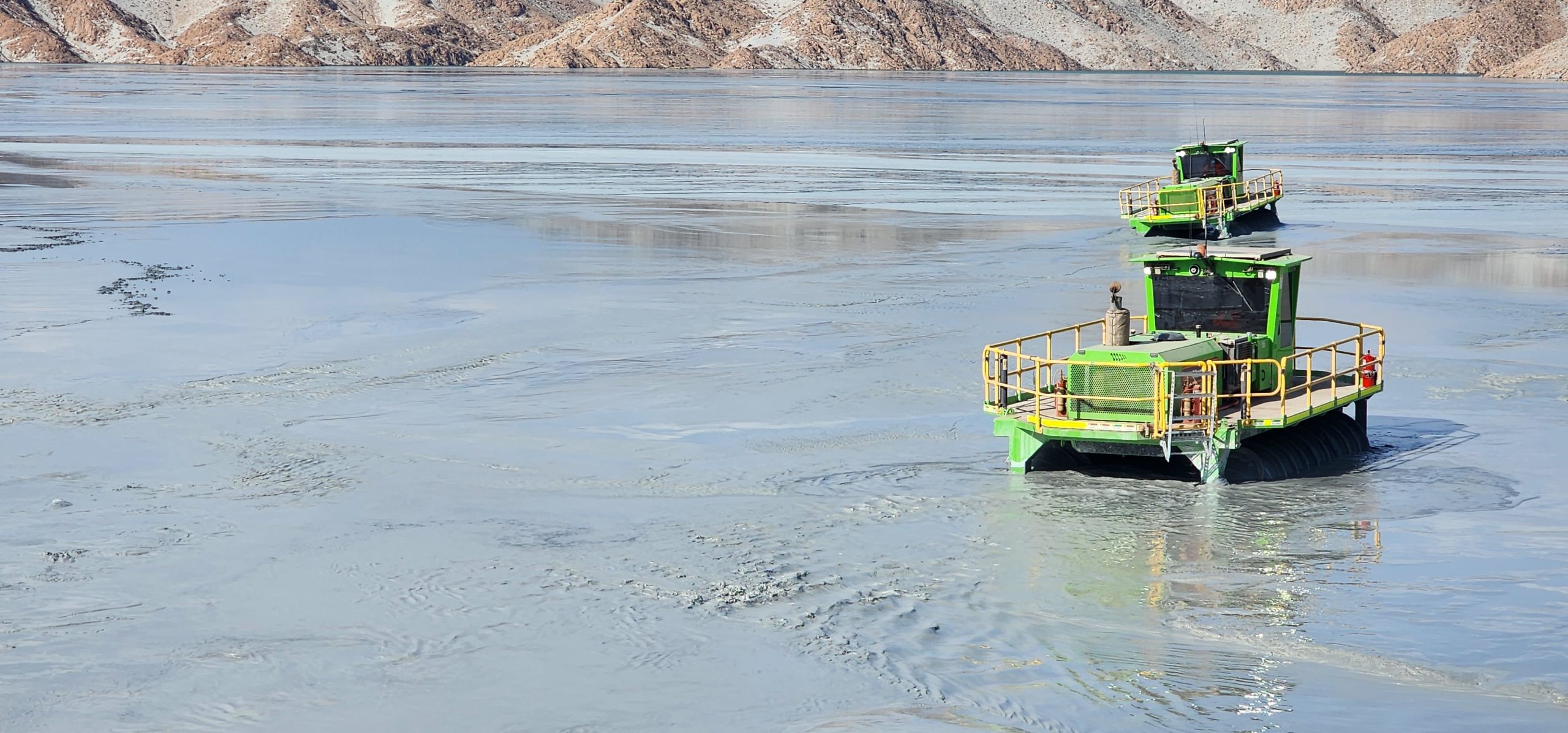
Phibion’s Amphirol MudMaster®, part tractor-part boat, operates directly on tailings dams, compacting material and recovering water as part of the AMC process.
Now equipped with dielectric sensors, the machines collect thousands of data points each day, updating every 10 seconds.
Operators gain real-time visibility of moisture distribution and can target compaction efforts precisely, reducing operational risk and improving water recovery efficiency.
The first commercial deployment of the integrated sensor system occurred in Western Australia in mid-2025.
Phibion now has more than a dozen sensor-equipped AMC systems operating globally, transforming how tailings are monitored and managed.
Mr Janse said tailings management had become a major industry focus.
“Tailings are the backend of the mining process that traditionally everyone just wanted to get rid of and forget about, because they didn’t generate any money. The focus of many companies has been getting the ore out of the ground, processing and selling it,” he said.
“But that all changed over the last decade after two very big tailings dam collapses in Brazil. Hundreds of people were killed and the spillage of toxic sludge caused huge environmental harm.”
Mr Janse said Phibion was a “proud Queensland company” and working with a research partner from UQ had been incredibly rewarding.
Related highlights

Life Sciences
New national koala genetics tool closes a dangerous knowledge gap
Reseachers from UQ have developed Australia’s first commercially available, standardised koala genetic marker panel.

Physical Sciences
Using quantum physics to keep fibreoptic data safe from harm
Using quantum physics to keep data safe

Life Sciences
UQ technology aids early detection of lymphoedema in cancer patients
Developing bioimpedance spectroscopy devices to improve quality of life for cancer survivors


